# gramsrv
`gramsrv` is a Go implementation of a Telegram-like MTProto server, focused on
real client compatibility, repeatable protocol research, and self-hosted chat
experiments.
[Website](https://telesrv.net) · [Discussion group](https://t.me/telesrv_chat) · [Channel](https://t.me/telesrv) · [中文 README](README.zh-CN.md)
`gramsrv` is independent and unofficial. It is not affiliated with, endorsed by,
or sponsored by Telegram or the official Telegram team.
## Highlights
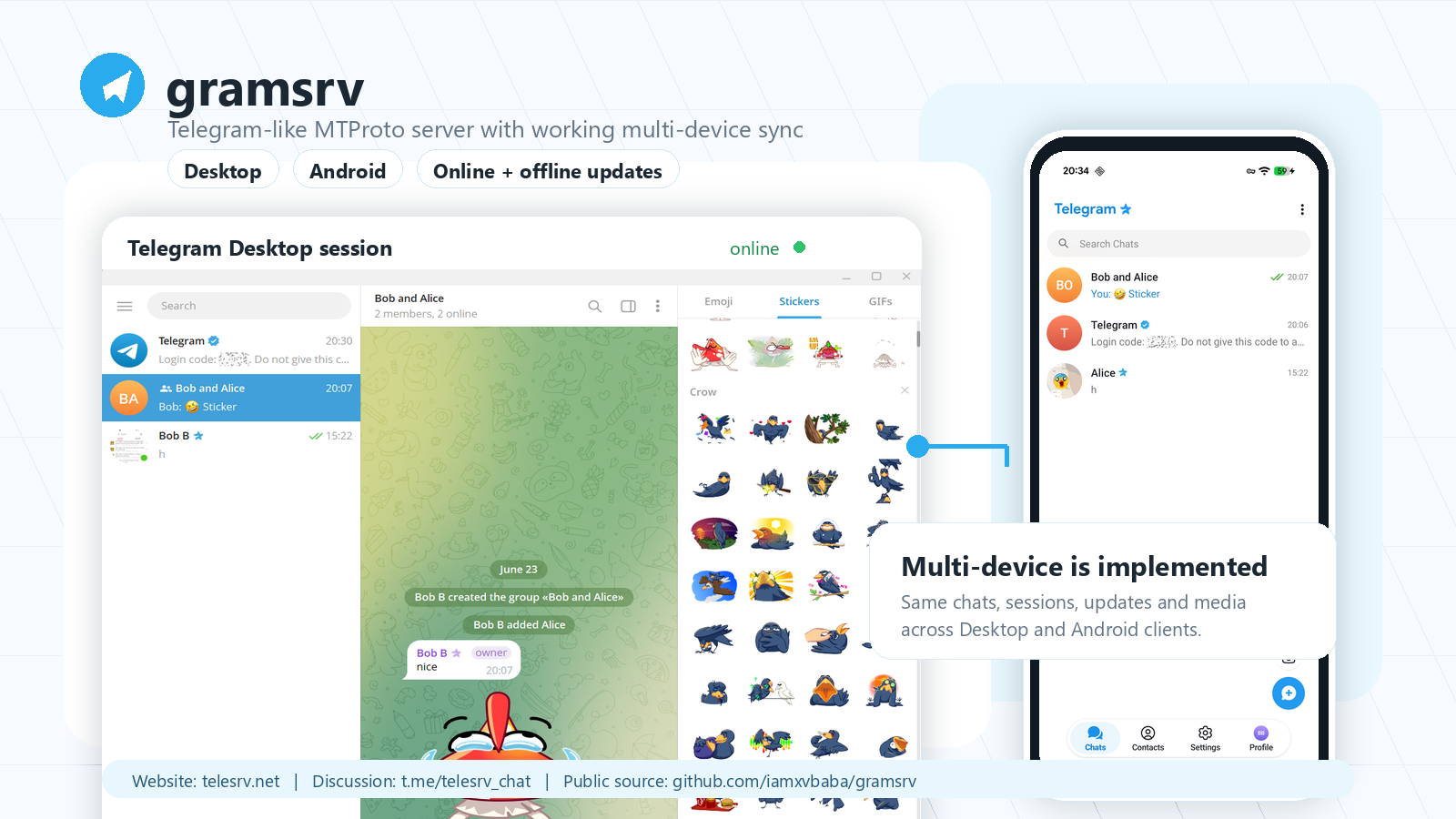
- **Multi-device is implemented.** Telegram Desktop and Android clients can use
the same server state, with scoped sessions, online fan-out, current-session
exclusion, and offline recovery through update difference APIs.
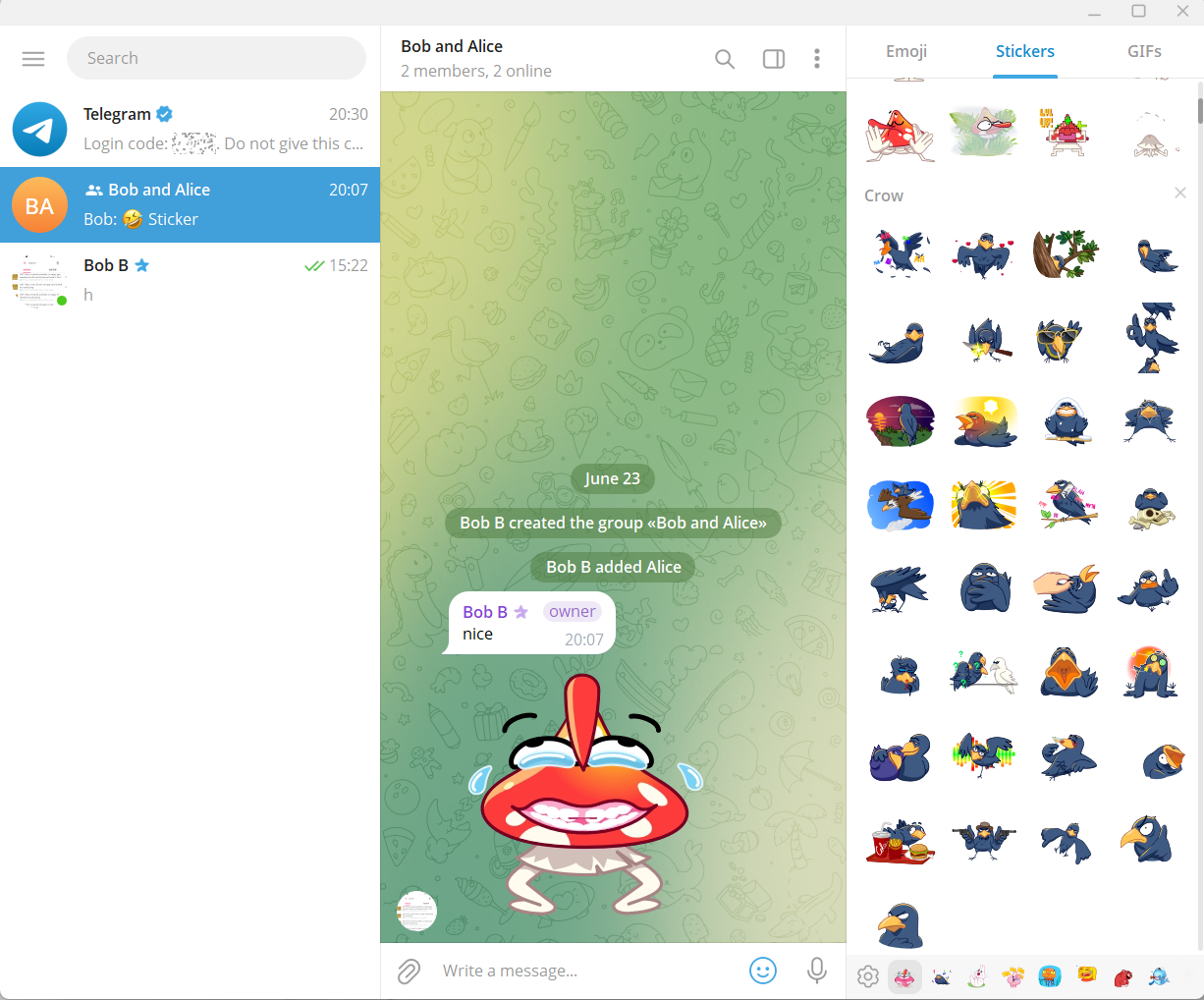
- **Telegram Desktop is the primary compatibility target.** The public build
tracks a pinned TDesktop baseline and keeps compatibility work documented.
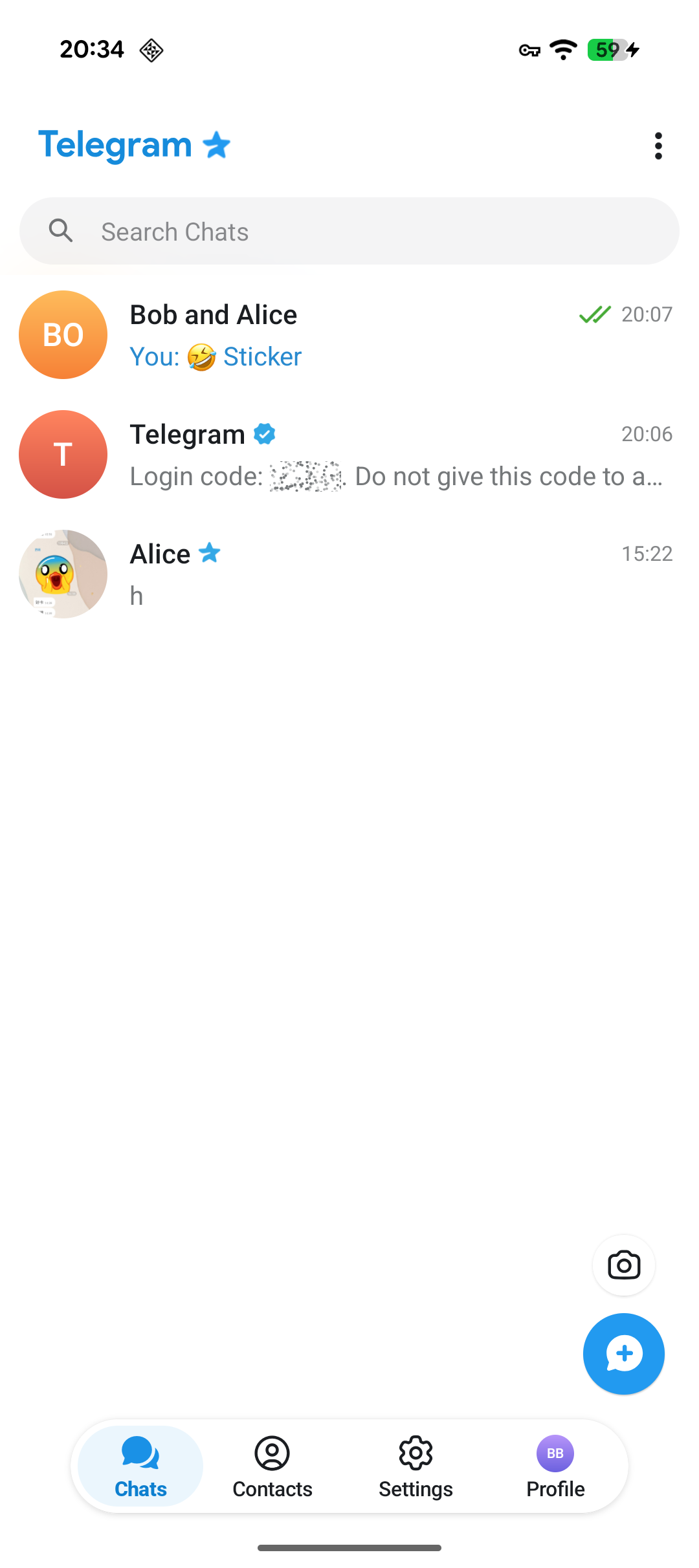
- **Android compatibility is active.** The current public screenshots include a
patched Android client connected to the same server path.
- **Core chat paths work today.** Login, users, contacts, dialogs, private
messages, supergroups/channels, media/files, profile/channel photos,
stickers, reactions, language packs, and presence are covered on the main
path.
- **Production boundaries are explicit.** Large-scale public channels,
multi-DC/file-DC/CDN, Bot API, payments, stories, Premium business logic,
abuse controls, and production object storage are outside the current public
scope.
For downloads, public information, and the current hosted experience entry,
visit [telesrv.net](https://telesrv.net). For questions, compatibility reports,
and development discussion, join [t.me/telesrv_chat](https://t.me/telesrv_chat).
## Screenshots
| Telegram Desktop | Android |
|---|---|
|  |
|  |
## Repository Layout
```text
cmd/telesrv/ server entrypoint
deploy/ docker-compose and PostgreSQL migrations
internal/mtprotoedge/ MTProto transport, auth key, session, ack/resend
internal/rpc/ TL router and Telegram Desktop compatibility handlers
internal/app/ domain services
internal/domain/ protocol-independent domain models
internal/store/ store interfaces and memory/postgres/redis backends
docs/ compatibility notes and module design docs
```
## Quick Start
Requirements:
- Go 1.25 or newer
- Docker Desktop or Docker Engine with Compose
- OpenSSL, if you want to build a matching Telegram Desktop client
Start PostgreSQL and Redis:
```powershell
docker compose -f deploy/docker-compose.yml up -d
```
Build and run the server:
```powershell
go build -o bin/gramsrv.exe ./cmd/telesrv
.\bin\gramsrv.exe
```
On first start, `gramsrv` creates `data/server_rsa.pem`, applies all database
migrations, seeds bundled language packs, and listens on `0.0.0.0:2398`.
Useful development environment variables:
| Variable | Default | Meaning |
|---|---:|---|
| `TELESRV_LISTEN` | `0.0.0.0:2398` | MTProto listen address |
| `TELESRV_ADVERTISE_IP` | `127.0.0.1` | IP written into `help.getConfig` |
| `TELESRV_DC` | `2` | self-hosted DC id |
| `TELESRV_DEV_AUTH_CODE` | `12345` | fixed login code for local development |
| `TELESRV_POSTGRES_DSN` | local Compose DSN | PostgreSQL connection string |
| `TELESRV_REDIS_ADDR` | `localhost:6399` | Redis address |
| `TELESRV_STICKER_SEED_DIR` | `data/sticker-seed` | optional exported sticker/reaction seed directory |
The optional sticker seed directory is skipped when it does not exist.
## Client Compatibility
Stock Telegram clients will not connect to `gramsrv` because they trust
Telegram's production DC list and RSA keys. Use a patched experience client from
the [official website](https://telesrv.net), or build your own client with a
minimal protocol patch.
Current Telegram Desktop baseline:
- Telegram Desktop commit: `9caf32dffc90ddd9bb08ad5777b865f729fa167b`
- TL layer: 225
- Local DC: `127.0.0.1:2398`, DC id `2`
After `gramsrv` generates `data/server_rsa.pem`, export the matching public key:
```powershell
openssl rsa -in data/server_rsa.pem -RSAPublicKey_out -out data/server_rsa.pub
```
Patch `Telegram/SourceFiles/mtproto/mtproto_dc_options.cpp`:
1. Replace the built-in production/test DC lists with your `gramsrv` endpoint.
2. Replace both `kPublicRSAKeys` and `kTestPublicRSAKeys` with
`data/server_rsa.pub`.
3. Add `Flag::f_tcpo_only` to the built-in DC flags.
Keep the client patch minimal: endpoint, RSA key, and TCP-only flags only.
## Multi-Device Smoke Test
Use separate client working directories so sessions do not share local `tdata`:
```powershell
$tdesktop = "C:\path\to\tdesktop\out\Debug\Telegram.exe"
Start-Process $tdesktop -ArgumentList @("-workdir", "$PWD\.tdata-alice")
Start-Process $tdesktop -ArgumentList @("-workdir", "$PWD\.tdata-bob")
```
Log in with different phone numbers. In local development, the login code is
`12345` unless you changed `TELESRV_DEV_AUTH_CODE`.
Recommended checks:
- Send private messages, stickers, media, replies, forwards, edits, deletes,
and read receipts between two users.
- Keep one device online and restart another device to verify offline
`updates.getDifference` recovery.
- Open the same account from multiple sessions and confirm current-session
echoes are not duplicated while other online sessions receive updates.
- Check server logs for no new `NOT_IMPLEMENTED`, `Unhandled RPC`, `bad_msg`,
panic, or internal errors.
## Documentation
- [Compatibility matrix](docs/compatibility-matrix.md)
- [Telegram Desktop patch notes](docs/tdesktop-patch-notes.md)
- [Persistence layer](docs/persistence-layer.md)
- [Message module](docs/message-module.md)
- [Channel module](docs/channel-module.md)
- [Performance audit](docs/performance-audit.md)
## Contributing
Compatibility-driven contributions are welcome. Useful areas include Telegram
Desktop and Android reports, reproducible RPC traces, focused bug fixes,
multi-device update tests, performance work on already implemented paths, and
documentation that makes local setup easier.
If a change affects visible client behavior, include the client version/commit,
the RPC path you tested, and the server log result.
|
## Repository Layout
```text
cmd/telesrv/ server entrypoint
deploy/ docker-compose and PostgreSQL migrations
internal/mtprotoedge/ MTProto transport, auth key, session, ack/resend
internal/rpc/ TL router and Telegram Desktop compatibility handlers
internal/app/ domain services
internal/domain/ protocol-independent domain models
internal/store/ store interfaces and memory/postgres/redis backends
docs/ compatibility notes and module design docs
```
## Quick Start
Requirements:
- Go 1.25 or newer
- Docker Desktop or Docker Engine with Compose
- OpenSSL, if you want to build a matching Telegram Desktop client
Start PostgreSQL and Redis:
```powershell
docker compose -f deploy/docker-compose.yml up -d
```
Build and run the server:
```powershell
go build -o bin/gramsrv.exe ./cmd/telesrv
.\bin\gramsrv.exe
```
On first start, `gramsrv` creates `data/server_rsa.pem`, applies all database
migrations, seeds bundled language packs, and listens on `0.0.0.0:2398`.
Useful development environment variables:
| Variable | Default | Meaning |
|---|---:|---|
| `TELESRV_LISTEN` | `0.0.0.0:2398` | MTProto listen address |
| `TELESRV_ADVERTISE_IP` | `127.0.0.1` | IP written into `help.getConfig` |
| `TELESRV_DC` | `2` | self-hosted DC id |
| `TELESRV_DEV_AUTH_CODE` | `12345` | fixed login code for local development |
| `TELESRV_POSTGRES_DSN` | local Compose DSN | PostgreSQL connection string |
| `TELESRV_REDIS_ADDR` | `localhost:6399` | Redis address |
| `TELESRV_STICKER_SEED_DIR` | `data/sticker-seed` | optional exported sticker/reaction seed directory |
The optional sticker seed directory is skipped when it does not exist.
## Client Compatibility
Stock Telegram clients will not connect to `gramsrv` because they trust
Telegram's production DC list and RSA keys. Use a patched experience client from
the [official website](https://telesrv.net), or build your own client with a
minimal protocol patch.
Current Telegram Desktop baseline:
- Telegram Desktop commit: `9caf32dffc90ddd9bb08ad5777b865f729fa167b`
- TL layer: 225
- Local DC: `127.0.0.1:2398`, DC id `2`
After `gramsrv` generates `data/server_rsa.pem`, export the matching public key:
```powershell
openssl rsa -in data/server_rsa.pem -RSAPublicKey_out -out data/server_rsa.pub
```
Patch `Telegram/SourceFiles/mtproto/mtproto_dc_options.cpp`:
1. Replace the built-in production/test DC lists with your `gramsrv` endpoint.
2. Replace both `kPublicRSAKeys` and `kTestPublicRSAKeys` with
`data/server_rsa.pub`.
3. Add `Flag::f_tcpo_only` to the built-in DC flags.
Keep the client patch minimal: endpoint, RSA key, and TCP-only flags only.
## Multi-Device Smoke Test
Use separate client working directories so sessions do not share local `tdata`:
```powershell
$tdesktop = "C:\path\to\tdesktop\out\Debug\Telegram.exe"
Start-Process $tdesktop -ArgumentList @("-workdir", "$PWD\.tdata-alice")
Start-Process $tdesktop -ArgumentList @("-workdir", "$PWD\.tdata-bob")
```
Log in with different phone numbers. In local development, the login code is
`12345` unless you changed `TELESRV_DEV_AUTH_CODE`.
Recommended checks:
- Send private messages, stickers, media, replies, forwards, edits, deletes,
and read receipts between two users.
- Keep one device online and restart another device to verify offline
`updates.getDifference` recovery.
- Open the same account from multiple sessions and confirm current-session
echoes are not duplicated while other online sessions receive updates.
- Check server logs for no new `NOT_IMPLEMENTED`, `Unhandled RPC`, `bad_msg`,
panic, or internal errors.
## Documentation
- [Compatibility matrix](docs/compatibility-matrix.md)
- [Telegram Desktop patch notes](docs/tdesktop-patch-notes.md)
- [Persistence layer](docs/persistence-layer.md)
- [Message module](docs/message-module.md)
- [Channel module](docs/channel-module.md)
- [Performance audit](docs/performance-audit.md)
## Contributing
Compatibility-driven contributions are welcome. Useful areas include Telegram
Desktop and Android reports, reproducible RPC traces, focused bug fixes,
multi-device update tests, performance work on already implemented paths, and
documentation that makes local setup easier.
If a change affects visible client behavior, include the client version/commit,
the RPC path you tested, and the server log result.